


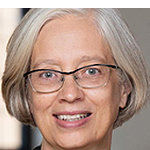
Karen Westwood
GLL'S MARKETING MAVEN: FALL 2022
Law Library Director
Hennepin County Law Library
We keep waiting for the dust to settle post-pandemic, but a thought occurs to me. What if the dust doesn’t settle? What if the future holds only constant change and endlessly revised expectations? Karen Westwood and the Hennepin County Law Library provide great examples of seizing unique marketing opportunities from arising circumstances to create awareness of her library and their services. These include four very different programs that one might not necessarily think of when looking at outreach opportunities.
1. Karen, when we first started talking about showcasing your outreach efforts, I noticed that you seemed a bit hesitant about focusing on projects that were not directly “on brand” (for lack of a better term) for traditional county law library services. I admit that made me even more curious. Tell me about the Afghan refugee events that HCLL has been participating in. What is the program, how did you get involved, and what services does HCLL provide?
Barbara, it’s true that I’m always trying to make more people aware of Hennepin County Law Library and here’s an example of that paying off. I have worked to partner with my Hennepin County Library (HCL) public library colleagues ever since I began working here about seven years ago. Earlier this year, HCL was approached by a local Rotary group. They were hosting monthly “get to know about living in Minnesota” sessions for newly-arrived Afghan refugees. My HCL colleagues enthusiastically signed up AND reached out to us in the law library. It seemed to them that there would be a need for information on legal rights for these new arrivals and the same kinds of questions we all have would be common for them too – landlord/tenant, small claims, etc.
Our new Outreach Coordinator has been to two of these sessions and, indeed, talked to someone about a used car he had purchased that didn’t come with a clean title. She was able to make some good referrals for this patron. She also carries with her “Legal Stuff” a booklet prepared by the Hennepin County Bar Association (Legal Stuff Booklets (mnbar.org)). This booklet was originally written for high school students, but we’ve found it to be a very helpful overview for many non-attorney patrons – and the participants in these resettlement events take them to study at home. It’s unclear how long these resettlement events will continue, but we plan to participate in them for as long as they are beneficial.
2. I was intrigued by your partnership with the Hennepin County Purchasing and Contracting Department for outreach to small businesses. As county law libraries, we have so many areas of overlap with county services, but we operate in silos. Tell us a bit about this partnership and how it came about.
Last year I joined a countywide group called the “Disparities Reduction Community of Practice.” This is a group of employees throughout the county who compare notes on initiatives they are trying – no matter how small – to reduce disparities in our community (particularly racial disparities). In that group I worked on a presentation with a man who works in the county purchasing department. I’ve been learning how important purchasing and contracting is for a county – it’s not only through hiring that counties can reduce disparities. Paying attention to who gets county contracts can also make a big economic impact.
Through my purchasing friend I met a county employee whose job it is to help small business owners qualify to get county contracts. She meets with entrepreneurs and others and walks them through the variety of forms needed to succeed. As we all know, new entrepreneurs – particularly women and minority owners - don’t always have the technology and experience to help navigate complicated government requirements. We are now set up to try a four-month pilot project in which we’ll make our conference room available one day a month for assisting these folks. Our first event, on September 14 saw a dozen attendees show up within the first hour so we’re cautiously optimistic that this will really fill a need.
The law library connection on this is a bit tenuous, but we created a short list of popular titles related to establishing and running a business and will have it available to hand out during these sessions. And if anyone has to wait to be seen, we’ll encourage them to browse in the law library while they wait. I’m looking forward to where this takes us.
3. In our conversation you mentioned a partnership with a colleague who runs a private legal research and writing business. If I’m not mistaken, the plan is for you (or your staff) to be regular guests on the podcast and discuss interesting legal research questions that have come up and the resources available at HCLL to help answer the questions. I love this idea because it allows you to get in the podcast game without having to do all the production legwork that goes with hosting your own podcast. Tell us more!
Happy to tell you about my pal Mike Carlson and his foray into a small legal research and writing business (https://graypaperlegal.com/). As part of building his business he thought he’d produce a weekly webcast about some interesting aspect of legal research and asked me to co-host with him. Mike spent quite a few years as a Reference Attorney for Westlaw, and then had some roles at the state bar association where I met him when he asked me to present CLEs on occasion. Mike and I often have wide-ranging discussions about research and tech so this seemed like a great chance to get the Hennepin County Law Library name out there. We plan to air a 15-20 minute segment in a weekly webcast Mike is calling “Gray Matter(s).” So far we’ve recorded two – one session on finding a regulation on “cabotage” which you can see now on the website, and another on the neural net technologies behind Casetext’s new search function. We hope to keep it casual and informative. I was still undecided as to whether to accept Mike’s invitation when I went to an AALL session in Denver called “Shameless Self-Promotion for Law Librarians” featuring Greg Lambert and Jean O’Grady. I spoke to Jean afterwards and she encouraged me to take advantage of this opportunity to get the word out about my library and the value of professional researchers. So I’m on board now – we’ll see how many viewers we get. This is an example of an immediate benefit to attending an AALL educational session!
4. Karen, you also mentioned that the Hennepin County jail is undergoing a cultural change and the law library was asked to teach regular workshops in the jail as part of project HOPE - “Helping Others by Providing Education.” What are the primary legal research needs in the jail and what resources are available? How do you envision your participation functioning in the context of this program’s mission to help break the cycle of incarceration by giving inmates opportunities to develop skills they will need for success upon release?
We have the good fortune to be right across the street from the “Public Safety Facility” – what we know as the jail. We have provided information to written requests from the jail for some years now. But the sergeant we’ve been working with wondered if we might present some workshops on expungement (everybody around us loves expungement these days!). We didn’t think expungement seemed like the right topic, given that most folks in jail haven’t even begun serving their sentences yet, but we were interested in having a conversation. We landed on a plan to visit the jail one hour each week (in a different housing unit each week – we’ll cover the whole jail in a month). We’ll do a short presentation on legal research and then field questions. We don’t know yet what kinds of questions will be the most popular, but we plan to teach them a bit about research generally and then explain why we send the material we send. For instance, a typical jail letter will request “everything on” the statute they are charged with. We are likely to send them information from a state jurisprudence and a copy of the jury instructions for that offense. We can explain why this is a good way to get a handle on the important aspects of the charge and how the jury instructions clearly lay out what the state needs to prove. We’re having background checks done now and hope to get trained and started within the month.
At the end of the day, Barbara, I’ve revised my pre-pandemic goals of having more people coming into the law library and using the law library. It is now my goal that our county residents know that there is a county law library that is open to them and that we’ll provide help in using the resources. I believe that the usage metrics will increase after that. But currently our biggest hurdle is that we are invisible to so many people (including people who work for our county and for the courts!). Just getting out more and working with different entities will help spread the word – at every outreach event it’s not just the residents who learn about us, it’s the other organizations who are also appearing at the event. As we plant more seeds and get the word out, I’m hopeful that more and more residents will think to turn to our law library whenever they have a legal issue they want to know more about.
Wow, Karen what an amazing array of outreach programs you’ve got going – Marketing Maven, indeed! I think you’ve hit the nail on the head with your revised goal of what success looks like for law library outreach. With increased expectations that law library services (and government services in general) will be remotely accessible, driving traffic into our physical library spaces becomes less and less likely. Blunting the invisibility factor and increasing awareness that the law library exists and can offer cognizable assistance encapsulates the true value of law library outreach. Thanks for taking the time to share your expertise and for providing new ways to think about marketing ourselves!